
Ibrahim
Abdullah Ibrahim (1934-2026)

Abdullah Ibrahim, pianist, now follows James Blood Ulmer, guitarist, who died a few weeks ago; Sonny Rollins, saxophonist, who passed a few weeks before Ulmer; Gunter Hampel, multi-instrumentalist, former husband of Jeanne Lee, who passed a few weeks before Rollins; David Henderson, poet, who wrote so much of the music, and who passed a few days before Hampel; Éliane Radigue, composer, who passed a few months prior to Henderson. From the music and back into it, the song they have all become.
I sometimes wonder, speculatively, if the reasons these artists are dying now, the way that they are, falling like dominoes, it seems, is not just because of the gradual loss of generation, the inevitable factor of ageing—that “natural” fact that is also never not socially experienced, socially produced—but because the world they spoke into and of has not come to pass, because we are letting the world as it exists now continue, because that world continues in “our” name. For those who create another world in their art still have to survive this one, even when they ride the relatively safe zones of shelter atop the rising waters around.
I wonder, that there is no space for their spirit in this new paradigm, even as a source for extraction, as the trillionaires openly talk what the economist William Nordhaus called the “euthanasia of the laboring classes”, the sacrifice of whole swathes of the global proletariat; as sanctioned genocides and ceasefires that are not ceasefires pummel themselves through misinformation and state enforcement and corporate profiteering; and yet vast swathes continue to believe, against their own interests, that it’s the weakest who are the greatest threat and who should be shouted down and cast out, repelled with ocean mines or border fences or burned out of their houses in the pogroms in all but name flaring across every continent on the planet.
I think of these litanies for artists I always seem to be writing, turning passage into a factor of continuance, the pathos they’re sold on, the retrospective backwards glance always preferred to the moment of live lithe late work, contradiction and difficulty: late work, even where that entails the repetition of a set repertoire, a set of stuttered stammered stumbling looping paths back to the source, like the story I was told about the bandleader who, fluid as ever in their playing, would nonetheless keep calling the same tune, over and tune, until reminded (by ear) to move on. I think of mourning, melancholia, nostalgia, the logic of defeat and loss: turning ever backward toward the city on the hill or the burning city or the city overwhelmed by flood, refusing to move on. Making garlands out of the wreckage, spreading magic carpets there. Dwelling excessively on the pathos of ending, addicted to cadence, to the closing chord, replayed. A heritage industry of embalmed corpses, a Lenin’s tomb of art.
I think of those litanies of artists and then I think of other lives, other names. Yves Sakila killed by security guards in Ireland. The four migrant workers burned alive in an attack on their car by gangmasters in Italy—not named. Those killed in Israeli airstrikes on Beirut, “ceasefire” or no ceasefire—not named. How, in writing, to do anything but juxtapose those lists; how to do anything but turn them into lists.
But music, it’s been said, is the last of the senses to leave: after language, on the edge of consciousness, life/death, waking/dream. Is limbo, the gate to pass through. So to remark on that moment at its ending is part of the work that music does, in trance erasing beginnings, endings, in cadence prolonging or truncating them.
Below, in memory of Abdullah Ibrahim, a report on Ibrahim’s concert at HKW, Berlin, from September 2024, originally one of the first posts on this site.
“You invest in loss”
Abdullah Ibrahim Trio, Haus der Kulturen der Welt, Berlin, September 7th 2024.
[Ibrahim played in alternating solos and duos with flautist Cleave Guyton and bassist Noah Jackson, both longtime members of his band, Ekaya.]
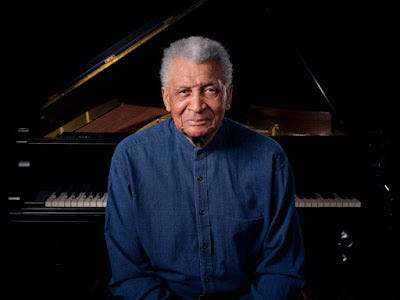
For decades, Abdullah Ibrahim’s solo performances have involved long medleys in which fragments of his familiar songbook are linked like flowers in a garland. In the past, these were often driven by propulsive groove. As he gets older and older, the medleys get slower and slower, music stripped back to the bare bones—a blues scale, a Monkian dissonance, a rich, impressionistic chord. Late style, pared down, all ornamentation cleared away.
As Ibrahim once remarked of Good News From Africa, his superlative 1973 duet with bassist Johnny Dyani, “[when] you play bebop, you fill out a space. When you play our music, you don’t play notes, you just play space!” Without a rhythm section, Ibrahim’s rubato playing unfolds introspectively, in flexible, slow time. Chords, melodies, transitions come together as in a waking dream, in which each phrase has simultaneous fragility and depth. It’s as if the weight of history accumulated in the pianist’s fingers at once lends them the collective power to strike the keys, and weighs them down, so that each note played must be wrested from the accumulated ghosts of time, ageing and history. To play is to “invest in loss”, Ibrahim remarks in a recent interview. One must “strike the note [...] with the utmost sincerity”, because “you don’t expect to get anything in return”.
We might, I think, view all of Ibrahim’s late performances as essentially variations on the same structure. In a 1984 interview with Graham Lock, Ibrahim linked the role of repetition in his music to the Islamic Tariqa, or state of trance. “At home we have chants – you say: ‘There is no God but He’; say that for five, ten hours, you’ll get stoned! [...] That’s where the music comes from and its purpose is to put you in that stage[.]” Previously, this could be heard in the repeated, loop-like structures which guided and grounded Ibrahim’s music. But his current mode, a set of repeated ruminations on the same pieces, might too be linked to that state of Tariqa, to the way a prayer follows a set pattern in order to address questions that remain new
