
“...and the music is unstoppable”
The career of bassonist Karen Borca

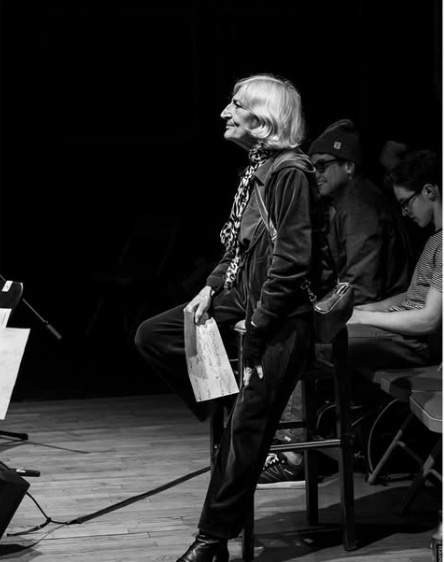
Over a fifty-year career, Karen Borca has manifested an uncompromising committment to playing free music—dense, knotty, vibrant, tough unsentimental, and committed to the extended practice of open improvisation. And all this on that toughest of woodwind instruments, the bassoon.
Borca remains best known for her longstanding association with Cecil Taylor—whom she encountered as a student at the University of Wisconsin in the early 1970s, and for whom she acted as copyist and ensemble coordinator—and Taylor’s faithful saxophonist Jimmy Lyons, who would become both her key musical collaborator (and life partner). Though much of her work with Taylor went unrecorded, her contributions are key to the record made by Taylor’s Orchestra of Two Continents in 1985, Winged Serpent (Sliding Quadrants). On the albums she made with Lyons between 1978 and 1985—Push Pull, Riffs (1980), Wee Sneezawee, (1983), and Give It Up—and for that matter, with Paul Murphy (Red Snapper, Cloudburst) and Joel Futterman (Moments, Passage) during the same period—she is simply incandescent.
On these records, the songs’ dry, one-or-two-word titles—‘Gossip’, ‘Shackinback’, ‘Methods’ —act as containers for knotty and witty themes and extended improvised performances that sometimes seem like they will never stop, there’s so much energy and invention to go round. Moments of respite are relatively rare—though the Lyons-Borca remake of the first of Chopin’s Ballades, ‘Ballada’, on Give It Up, is a thing of wonder, all grimy elegant sweetness over the chug of brushes and arco, mood indigo. As quartet, with Jay Oliver on bass and Paul Murphy on drums, as quintet, with Enrico Rava or Raphé Malik or Munner Bernard Fennell’s crackling cello added, as embedded duet within all this, Borca and Lyons devote themselves entirely to a music made with no concessions, tapping into the light source, the life source, and refusing to let it go. Riffed wings of the serpent, rife with compressed bursting, snapping, moment to moment. The dragon awakening. Burning flame.
Listen to the solo that begins about four minutes into ‘After You Left’ from Push Pull: to the way Borca pushes, pulls, works her way around the sinuous grit and heft of the melody, silences and feints like shafts of light piercing a curtain; and in the opening and the closing thematic statements, to the way she and Lyons shadow each other, two voices utterly distinct yet like uncanny emanations of each other. And though the title suggests a kind of melancholic reflection, perhaps, a post-mortem or a word unspoken after the door’s closed, the feeling it gives is one of endless possible invention: that this is what it is truly and even without words to sing.
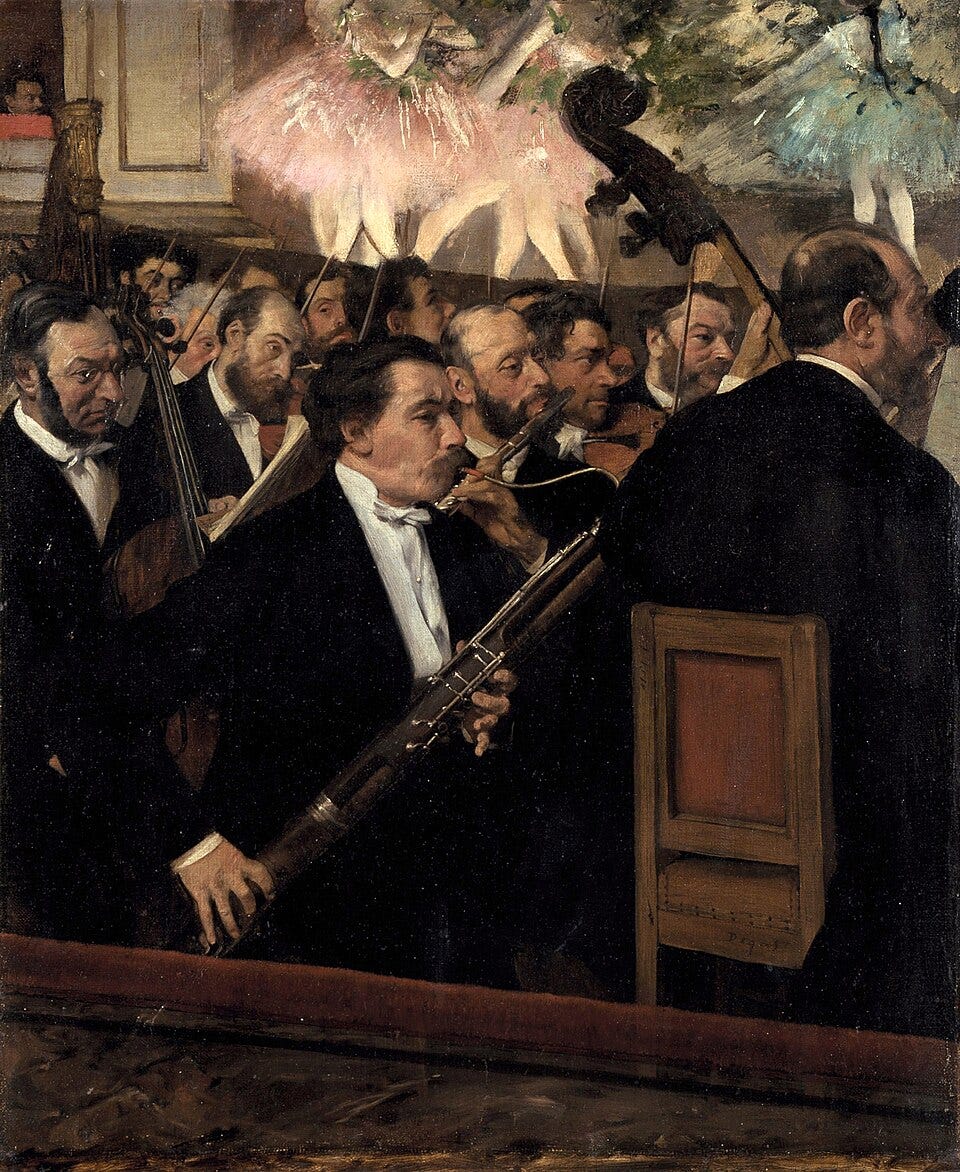
In 1868, composer and bassoonist Désiré Dihau commissioned a painting from Edgar Degas, L’Orchestre de L’Opera, to give the instrument a rare moment in the limelight. Yet though centre stage, the bassoon doesn’t quite fit the frame. The physical awkwardness of the diagonal playing position required translates in compositional terms, the bassoon’s diagonal slash dividing the space asymmetrically. Painted in the pit, the bassoon seems an instrument of labour, of the depths, yet capable of ascent, bassoon and cello both grounding and rising elements in the composition: bulk of instrumental body, bell and joint leading to thinness of the bocal, the crooked tube curving from joint to reed, as the bassoon ascends from its bass register growl upwards and out of the pit to support the flights of the ballet dancers lit up above who, for a moment, it upstages.
What sounds come to mind viewing this painting?
Perhaps…in Paris fifty years later, the calm before the storm: the reedy, high register lyricism of the solo that opens Stravinsky’s Rite of Spring—later adapted by Ornette Coleman for alto; perhaps, the contrabassoon in the opening of Ravel’s Concerto for the Left Hand, from depths to heights like an emergent sun, growl emerging into song, shadow into light; or, more likely, the sprightly themes in Dukas’s Sorceror’s Apprentice or Grieg’s In the Hall of the Mountain King; or, again, the deeper-register comic rumblings of the role of the grandfather in Prokofiev’s Peter and the Wolf or, for British listeners, of Vernon Elliott’s music for Oliver Postgate’s children’s TV series Ivor the Engine. In the world of the avant-garde, the great Lindsay Cooper in Henry Cow or her soundtracks to Sally Potter or the Feminist Improvising Group or with the late Mike Westbrook. Or the multiple extended techniques of the Sequenza that Luciano Berio wrote for the instrument.
Almost all of these examples come from classical music. But the quick-speed-dive-and-rise of Borca’s playing is another world; one might even say, another planet. The music that came to be known as jazz consisted of adapting, reconfiguring, redefining instruments invented for other purposes—the marching band, the parlor—and making them sing anew. And in that sense, Borca’s reinvention of the bassoon is in the tradition—a tradition of ceaseless invention, a tradition that is always radical, and that rarely takes the easy way out.
Bassoon was not, in fact, Borca’s first choice of instrument. As she told Ken Weiss in a 2018 interview for Jazz Inside, probably the most in-depth print source available on her work, she began as “a hotshot alto saxophone player in high school”. It was a teacher who recommended the switch to bassoon, as they thought her more likely to attain a scholarship on the rarer wind instrument as “there were too many saxophonists”. At the University of Wisconsin, Borca studied classical bassoon with John Barrows and Arthur Weisberg. This would not, however, be the ultimate direction of her career. In the 1970-71 academic year, Cecil Taylor taught at the university, and Borca enthusiastically took to his music, following him to Antioch College, Ohio upon her graduation, where she served as director for his ensembles, transmitting instructions to players and leading the group when he was absent.
